
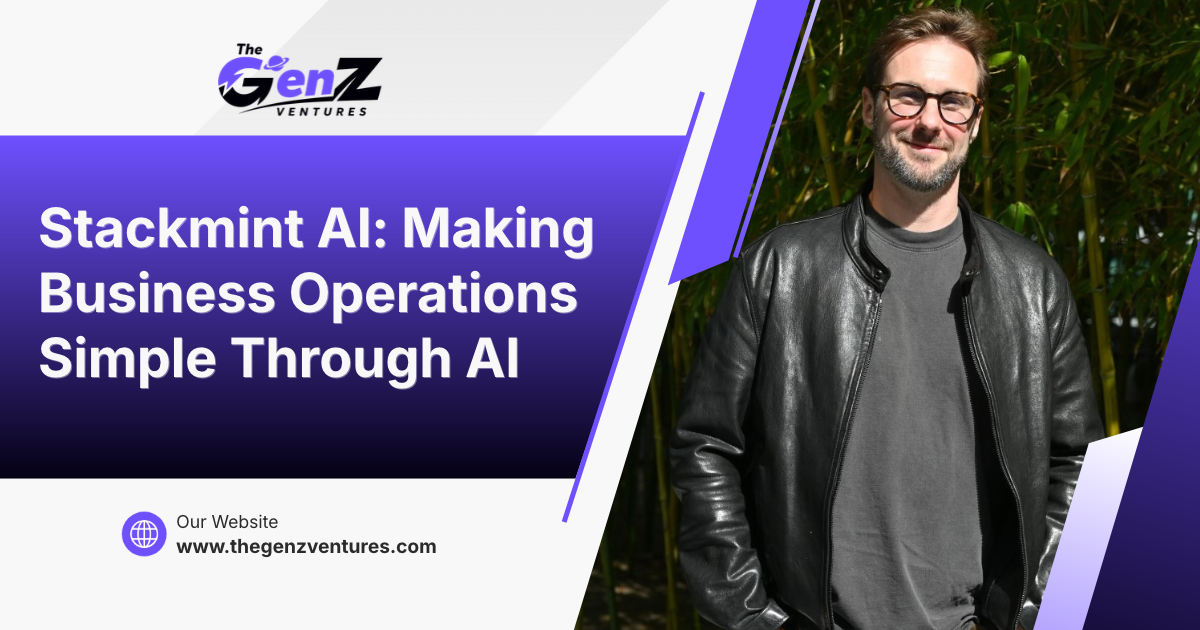
Founded by Florian Boymond, Stackmint AI is the runtime helping agencies and consultancies turn their repeatable methodologies into AI products they can deploy, control, and monetize across their clients. It gives them infrastructure to transform billable man-hours into scalable AI agent-hours. However, it still keeps the human significance alive by giving them control of final decisions.
Florian Boymond launched this business after extensive years of experience in enterprise technology. The key aim was to help companies leverage AI in a practical, secure, and scalable way. Today, Stackmint AI stands as a key AI tool for real business growth, making business operations more efficient, growth-oriented, and quick.
Table of Contents
Can you briefly introduce yourself and tell us about your business?
Hi, my name is Florian Boymond, and I am the founder of Stackmint AI. Stackmint is an AI runtime for agencies and consultancies, helping them turn their repeatable playbooks into governed AI products that they can deploy and monetize across clients.
Thus, the projects get completed faster, companies can serve more clients, and grow faster than their headcount. The best thing about the platform is that it does not completely replace the human touch; rather, it gives the final decision to a human supervisor. A conversion from man-hours to agent-hours is going to happen, and we’re the platform that supports this shift.
What inspired you to start Stackmint after having years of tech experience?
My inspiration came from the time when I worked with companies like Salesforce and startups such as Odaseva. I found a huge gap. Businesses found it challenging to work with siloed systems across complex software and data platforms. As a result, employees would spend hours repeating manual tasks, even when software was here to help.
But with the growth of AI, it became possible to delegate these mundane tasks to AI so humans could focus on the most important work, like making decisions, applying critical thinking, or using their good taste. Thus, it became clear that companies needed a platform that could help them organize, manage, and deploy their skills securely. This was the only inspiration point that motivated me to build Stackmint AI.
What challenges come with being an older millennial founder in an AI space?
My biggest challenge was to stand out in a crowded AI market. The common perception is that AI startups are essentially ChatGPT or Claude wrappers, and it can be hard to differentiate or make your voice heard, even when you have something genuinely different. Stackmint AI has invested heavily in building a platform that is ready for the enterprise, not a weekend orchestration project.
For instance, we spent time building robust governance features to ensure a model couldn’t make decisions it is not allowed to do. This is not trivial, adds lots of value to large companies, but much of that engineering is invisible to someone looking only at the AI experience. Being a millennial I think was an advantage in the sense that I have enough experience of large transformation projects to understand what is required but also the curiosity and energy to explore new technologies every day.
What’s one stereotype about the AI founder ecosystem that you want to break?
One big misconception is that building a product is very fast with AI. It is true that building a prototype is now incredibly fast. This technology is incredible. But when you work with companies, you quickly realize that the difference between a prototype and a production-ready product is immense. If you build a workflow in a few hours, you have actually done the easiest part. The difficult part is to make sure it can be packaged, deployed securely across clients, that it has rollback, version control and many other features that, taken together, represent much more work than the workflow itself. This is the place we operate in. We transform workflows into governed enterprise ready products.
Another issue is anthropomorphism. Many companies think enterprise AI should operate like a human, some for marketing reasons, some for lack of imagination perhaps. But if you think about it, some aspects of work are inherently human. Take for instance, responsibility and accountability. A human will do their best because they want to feel valued, recognized, and in the extreme case, because they don’t want to get fired. An AI doesn’t care about these things. So, there should be a human carrying the burden of responsibility and accountability.
What was your biggest fear when you launched your idea publicly?
In the beginning, I feared that people would call Stackmint “just another wrapper” or just a simple AI tool that is built around existing technology. I wanted people to notice that we have put a huge amount of hard work into it and made it a more advanced solution with powerful features for businesses. The million lines of code, complex routing, and planning behind the product are there to make it a true enterprise product, not just a simple tool following AI trends.
Did online communities or professional networks play a role in your growth? How?
Yes, they played a big role in our growth. We haven’t focused much on viral platforms like TikTok or other Gen Z social media channels. Instead, LinkedIn and specialized founder and business communities have been much more valuable for us. These are the places where I regularly connect with agency owners, consultants, and enterprise leaders who are dealing with real challenges, like losing clients to AI tools such as Claude or wondering how to deploy AI safely in their organization.
I stay active in these communities because it helps me get direct insights into what difficulties people are facing and what could be potential solutions for that. Moreover, we also speak at conferences like FOST or API World, where we can meet customers and partners in person. It helps us build credibility, trust, and form significant business relationships that often lead to long-term partnerships.
What does success mean to you at this stage of your life?
Success for me is building a business that is both revenue-oriented and sustainable over the long-term. I want to build a company that changes the way the entire industry works, while also making sure that my team stays motivated and does not burn out.
Apart from this, we value our partners. It is foundational that we help them scale quickly with AI products that create real, measurable results for their own clients. Finally, we aim to help them protect their intellectual property and prepare for a world where AI models are coming for them. So, if we are able to provide such lasting value for our partners, their clients, and our team at the same time, this is what I consider true success.
Have you faced any unique biases from investors when raising money?
One of the most basic traps that AI founders face today is when an investor asks them: What if OpenAI just builds this? Dealing with this question is challenging, as we have to educate them on the differences between foundational intelligence and governed workflow orchestration. Many investors have this conception that LLM providers will capture all the value in most industries.
However, the good news is that these conversations are now making a shift. It took time to educate investors on why separating execution from intelligence matters. Today, many investors already understand this idea. Companies are starting to ask: “If an open-source model can run this task at one-tenth the cost, do we really need a frontier model for it?”. Investors see these discussions and understand the value is shifting from the model to the workflow layer.
This is one of the biggest signs that the market is getting more mature and investors are becoming more sophisticated in how they review AI infrastructure ventures.
How do you bridge the generational gap between employees when building a fast-paced AI startup?
I love hiring passionate, hungry young talent. They are quick learners, adapt to new technologies naturally, and are not held back by traditional ways of thinking.
My role, as an older millennial founder, is to provide the bigger picture. I define the business strategy, the go-to-market direction, and the architectural principles that keep us focused. That ensures all that technical talent is solving problems customers are actually willing to pay for.
At the same time, having experienced leaders, like someone with 25 years at Microsoft, is equally important. They understand how large organizations make decisions, how enterprise customers think, and how to build products and teams that last. They also bring patience, mentorship, and a deep understanding of company culture and the pace of change in larger organizations.
Therefore, I get the best ideas by merging different perspectives from different generations of employees. The young team pushes us to move quickly by providing a unique perspective, and on the other hand, senior leaders help us build in a way that is more sustainable and aligned with customer needs.
How has being a millennial founder shaped your pragmatic approach to building an AI company?
Millennials lived through Web 2.0, like the internet boom, mobile apps, and subscription software. We have seen technologies come and go, and we have seen bubbles burst. So, we understand that behind the hype, there is a profound industry transformation, but also that it takes time, and the answer is not to blindly unleash an army of agents, but to have a strategy and bring people in during this process.
For instance, at the core of Stackmint AI is the principle that everything done on the platform should be auditable, inspectable, replayable. Everything is logged in a ledger. This is one of the ways we build trust.
What’s one small win that meant a lot to you in the beginning?
For many people, this would be a small win, but for me it was a validation of my idea. When we saw our first non-technical client successfully using our complex multi-agent workflow without the need for holding their hand, we knew we had made an impact. When they looked at the UI and said, “Oh, I understand how this works, it’s just like an inbox, but with AI agents drafting the work and waiting for my approval” that was a massive validation of our product vision.
What motivates you on days when things aren’t going as planned?
What motivates me is that the shift from man-hours to agent-hours no longer feels speculative. Every month we see more work move from pure human execution to human-supervised AI execution. The question is not whether it happens, but how it is governed, and who captures the economic value.
What excites you the most about the future of your industry?
The thing that excites me the most about this industry is freeing people from manual, robotic tasks so they can do things that humans are supposed to do, especially making decisions. It also creates massive amounts of value for professional services companies. I am incredibly excited to watch traditional consultancies and agencies transform into AI-native services companies with software like economics, while offering efficiency and security.
How do you see AI agents changing the broader startup ecosystem in the next 5-10 years?
AI agents are already handling parts of the QA, the outbound marketing, the CRM hygiene, and the baseline coding. In five years, a three-person startup will routinely have the operational output of a 50-person company from 2020. This is a massive shift. Startups will become intensely lean, and the founders who win will be the best orchestrators of work, not necessarily the best raw operators.
I believe that a lot more people will be starting new businesses and that the barrier to entry will become ridiculously low. I can see kids that are just getting out of school building their agent fleets and selling their services with their own company. And for employees, a lot of them will become agent managers, with their core job being applying their taste and judgement to what AI produces, and steering the work in the right direction.
What advice would you give to new entrepreneurs for building a successful business?
One piece of advice I would like to give to aspiring entrepreneurs is don’t build something just because the technology is cool. Find a bleeding neck in a specific industry and provide a solution. Talk to your potential customers until you understand exactly how they make money and exactly how they waste capital, and then build the bridge between the two.
Also Read : Share At Door Step: Anushka Jain’s Vision for Smarter Donations