
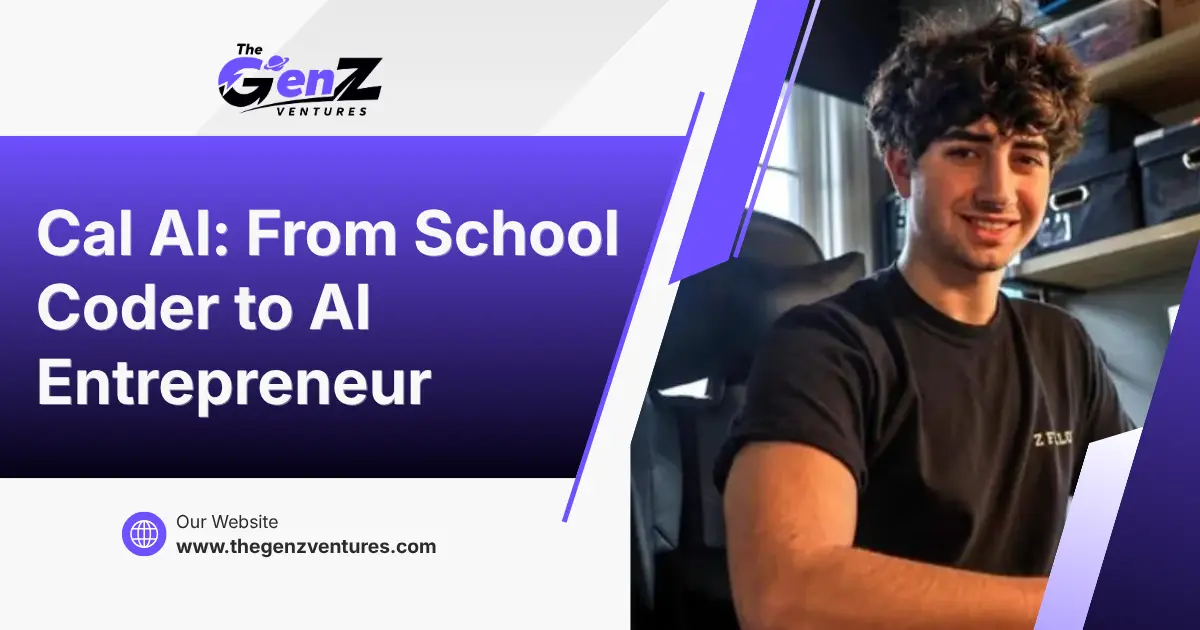
The journey of Zach Yadegari shows how a teenage coder produced a fast-scaling AI health-tech startup that later grew into a business generating nearly $30 million in annual revenue. As the current CEO and co-founder, Zach Yadegari developed an AI-powered calorie tracking app called Cal AI. It helps users track their calories by taking photos of their food and instantly estimating calories using the AI-trained model. This app gained immense attention because it removed the friction of manual food logging.
Launched in May 2024, Cal AI has been used by a range of people across iOS and Android phones. With a freemium model, this app offers subscriptions starting at just a few dollars per month. Therefore, the founder positioned the app with a simple idea, which is making nutrition tracking quick, easy, and accessible through AI.
Can you briefly introduce yourself and tell us about your business?
I am Zach Yadegari, co-founder and CEO of Cal AI. From a very young age, I started building apps out of curiosity and a keenness to solve problems that I personally faced. Similarly, when I faced a problem with traditional calorie apps, which required me to enter all the details manually, I knew I had to make something that is quick, simple, and more automated. This is how I built Cal AI: it allows users to take a picture of their food and get an instant estimate of the calories they are taking in.
I discussed the idea of Cal AI with my friend Henry Langmack, Blake Anderson, and Jake Castillo. I have known Henry since the coding camp, and met Blake Anderson and Jake Castillo through X (Twitter). Together, we started experimenting with an AI model that could review food images and provide an estimate of calories automatically.
We launched the app in May 2024, and it really performed exceptionally well. We are now a 30-person team and generate approximately $1.4 million in gross profit per month after app store fees. Apart from this, we also run a subscription model, where users can pay monthly or yearly for premium features. The amount of the subscription is budget-friendly. Thus, my goal with Cal AI is to make sure that it is one of the most widely used calorie tracker apps in the world.
What inspired you to start a business at such a young age?
My parents sent me to a coding camp in my early years, and I have been doing the code since I was 7 years old. However, I did not learn everything there, but I definitely gained an idea of what was possible. After that, I gained all the knowledge through YouTube and building small projects.
Apart from this, when I was 16, I already sold a gaming project called Totally Science for roughly $100,000. This boosted my confidence and opened my eyes to the thought that building online products can actually turn into profitable businesses. Therefore, I gave my all in building Cal AI.
In the early stages, Henry Langmack and I coded the app and tested several product ideas and features. Moreover, we also spent about $2,000 on an initial social media marketing test run. The response was really good than we expected. The attention to the app showed that users genuinely wanted a simple solution for nutrition tracking.
What challenges come with being a young founder that people often overlook?
Not being taken seriously was one of the biggest challenges for me as a Gen Z founder. I believe when you are young, people don’t take your opinions, product decisions, and business understanding seriously, especially in investor and partnership conversations. Navigating this was definitely a big challenge.
Another challenge was responsibility. We are a 30-person team, and many of them depend on us for their livelihood. This is the pressure that people do not always see from the outside.
Also, a personal challenge was that I started college at the University of Miami at 18. So, balancing school, social life, and operating a scaling company is extremely difficult. During one summer, I was spending almost 40 hours per week working on Cal AI and also managing schoolwork. At the same time, I maintained a 4.0 GPA, which demanded more balance in academics and startups.
Even when things look exciting from the outside, managing time and mental energy is one of the real challenges in our Gen Z startup story.
What’s one stereotype about young entrepreneurs that you want to break?
People usually think that young entrepreneurs become successful because of luck, hype, or social media attention. But this is not the case from my experience. With Cal AI, I experienced a lot of constant iteration, paid marketing experiments, and enhancement of the product over time. Apart from this, we also went all in for an influencer campaign, paid ads on platforms like TikTok and Instagram, and reinvestment into growth.
So, I did not get the overnight success. It was just continuous building, fixing mistakes, and learning from users every day.
What was your biggest fear when you launched your idea publicly?
When I launched Cal AI into the public domain, I thought that nobody would care. Being a part of Gen Z startup stories, we were not sure if people would trust an app that used AI to estimate calories from photos. According to me, it sounded a bit “too futuristic.” Therefore, we knew that our accuracy would be questioned.
Fear of failure in public was also one of my biggest fears. Once something is live on the App Store or Google Play Store, anyone can criticize it. However, I realized that not launching the app would be worse than failing in the public eye. So, we launched the app.
Did social media or online communities play a role in your growth? How?
Yes, social media played a huge role for us. We used several platforms like TikTok, Instagram, and influencer partnerships to make sure that Cal AI reaches a wide audience. Moreover, we invested heavily in paid acquisition and content-driven marketing.
In fact, many of my early-stage business relationships came through online communities and X (Twitter). A few people later became part of Cal AI.
In addition, we worked with fitness and nutrition experts who showcased this app to potential audiences in real life. Therefore, this early exposure helped us to get millions of downloads more quickly than we ever expected. Apart from this, Cal AI was also validated by significant online communities.
What does success mean to you at this stage of your life?
Success for me right now is not just revenue or valuation. Yes, Cal AI is a successful business, but what I care about more is making something that truly shifts how people interact with health and nutrition.
Success also means seeing real users benefit from something that I have built. One of the best moments is when someone shows me Cal AI on their phone and says they use it every day. Thus, my goal is to build multiple companies in AI long-term, so success is really about learning how to build strong and scalable products.
Have you faced age bias from investors, partners, or customers? How did you handle it?
Yes, at first absolutely. People naturally wonder if you can run a real company at age 17 or 18. Some investors and partners hesitated at first. I didn’t try to convince people with words; I just executed. Once Cal AI started to show strong growth, millions of downloads, and strong revenue, the conversation changed. Therefore, I believe that results are the only real way to fight age bias.
How do you hire or work with people from older or younger generations?
We hire on skill, experience, and mindset, not age. Our team is made up of people with different levels of experience, and I’ve learned a lot from people older than me. And the younger team members bring speed and creativity. I think the best environment is one where ideas are more important than hierarchy. It doesn’t matter how old someone is if they have a good idea. Regardless of a Gen Z startup, we welcome talent of all ages.
How has being a Gen Z/millennial founder shaped the way you build your company?
As a Gen Z founder, I’m so much about speed and experimentation. We don’t plan too much. Rather, we get to market fast, experiment with real users, and iterate. That strategy helped Cal AI scale faster in a very competitive space. It also means I’m very close to trends in social media and consumer behavior, which is important for a consumer app such as ours.
What’s one small win that meant a lot to you in the beginning?
One of the most meaningful early wins was seeing strangers use Cal AI in the wild. I saw people downloading the app, using it, relying on it to track their meals, and it felt real. It proved to me that this was not just an idea anymore. This was something people really needed. That validation early on gave me a lot of confidence to continue.
What motivates you on days when things aren’t going as planned?
I think about the long-term vision. Building Cal AI, you’re not building just one app; you’re building the way people understand nutrition and health through AI. That bigger mission helps me stay on point when things get stressful. Also, I’m motivated by the user growth and feedback, because it’s a reminder that real people are relying on what we’re building.
Moreover, one of my biggest motivations was my parents, who supported me throughout the journey. They have been so proud of everything that has been happening with Cal AI. In fact, my mom personally uses this app herself, which makes the entire experience even more meaningful to me.
What excites you the most about the future of your industry?
The most exciting thing for me is how AI will change personal health tracking. Today, people still have to log food manually or guess calories. In the future, I think AI will make this fully automatic and much more accurate. Such a change could transform the way millions of people approach health, fitness, and diet in their day-to-day lives.
How do you see your generation changing the broader startup ecosystem in the next 5-10 years?
I think my generation, Gen Z, is a lot more comfortable building fast and publicly. We don’t have to wait years to build companies. We experiment with ideas quickly and leverage AI and social media to grow faster and pivot quickly, leading to success stories of Gen Z startups across the world. This will make startups more global, faster-moving, and more experimental than ever before.
What advice would you give to new entrepreneurs for building a successful business?
My advice is simple: just get started. Most people wait until their idea is perfect. But in reality, you learn everything by designing and getting feedback from real users. Focus on solving a real problem, ship fast, and iterate on what people actually want, not what you think they want. This way, you will surely be able to build a successful business.
Also Read: The Story of Mercor: From High School to the World’s Youngest Billionaires
Copyright Disclaimer
The views and opinions expressed in this article are solely those of the author and are based on independent research and analysis. The content published on The GenZ Ventures is protected under applicable copyright laws. Any unauthorized copying, reproduction, distribution, or republication of this material, in whole or in part, without prior written permission from the original author or website owner, may result in legal action under the applicable laws of the land.