
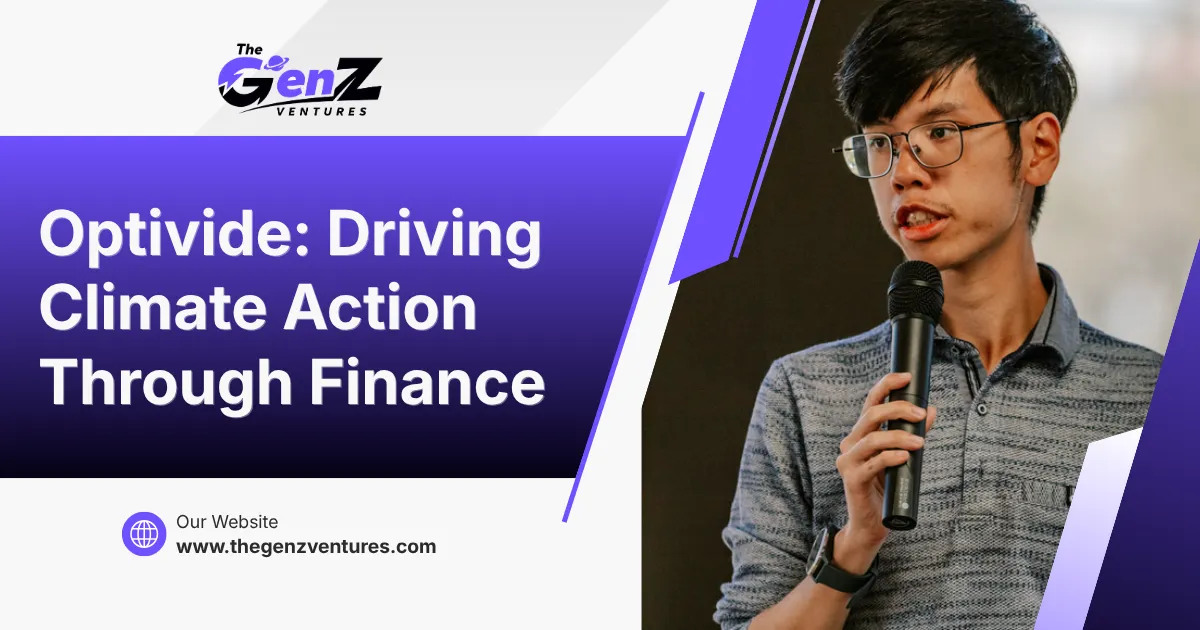
Climate change is one of the significant challenges that the world is facing today. These changes have immense potential to hamper the finances of individuals in the future. Many people still don’t know how they can make a difference to climate change while protecting their own financial future. This is where Danny, the founder of a mobile app Optivide, saw a gap. He believed that climate action and financial planning should go hand in hand. This helps people make smarter decisions that benefit both themselves and the planet.
Optivide mobile app allows people to have an in-depth understanding of how climate change can affect vital life goals such as saving money for retirement, buying a home, or planning for children’s education. By launching this startup as a Gen Z founder, Danny is making it clear that building a successful venture can also make a positive impact in the world and inspire people to take meaningful climate action.
Table of Contents
Can you briefly introduce yourself and tell us about your business?
My name is Danny, and I am the founder of Optivide, an AI-powered finance app for long-term climate action. Since we believe that if everyone, anywhere could take climate action without worrying about their financial confidence, we could increase our goal success rate to the net-zero goal. Through our app, we help users:
- Prepare Future Goals with Climate Simulation
- Search Climate Solutions As Per Their Needs
- Discuss Climate Practices with Global Community
Before I launched Optivide, I was working as a sustainability consultant where I helped businesses reduce greenhouse gas emissions, protect biodiversity, and adopt circular economy into their business operation. Moreover, my portfolio spans multiple niches, as I have served the finance sector as a CFA charterholder. Therefore, by merging my knowledge of finance and sustainability, I founded Optivide to help people build a secure future while making a positive impact on the environment.
What inspired you to start a business at such a young age?
Building a business was never part of my plan. However, as a Gen Z founder, I still have a story to tell about how I ended up launching Optivide.
When I was learning finance, one question used to pop up in my mind: If financial systems are so well designed, why are there still so many social problems that remain unsolved? This is where my career took a turn. Rather than following a corporate path, I started volunteering and meeting people from multiple communities. This gave me complete insight into how to deal with real-world challenges.
In addition, these experiences helped me understand deeply about social enterprises, impact investing, and businesses that bring positive change. I was more inclined towards solving climate issues as I knew it was going to have a huge impact on upcoming generations if we do not take precautionary measures right now.
This inspired me to build Optivide, which helps people make wise financial decisions and take simple actions to support a more eco-friendly future.
What challenges come with being a young founder that people often overlook?
As a young founder, one of the biggest obstacles I faced was having limited resources to start my venture. Similarly, several aspiring founders want to start their businesses but do not have enough funding, business experience, or the needed skills during the initial stages. This is the reason newcomers have to work even harder than experienced professionals to show their dedication and build credibility.
However, from my conversation with other founders, one does not need everything to start their entrepreneurial journey. Learning itself is one of the significant elements of building a startup. When you aim to solve a genuine problem, you gradually gain confidence, improve your skills, and understand your industry in a better way. Every challenge works as a stepping stone and teaches something valuable. So, I would suggest that one should keep learning and growing as they build a successful company.
What’s one stereotype about young entrepreneurs that you want to break?
People often think that young individuals do not have any experience in operating a business. I understand that having experience in a particular niche is valuable to build a successful venture, but it should not be the only factor that people use to judge someone’s potential. Every founder has their own journey, and success depends on how willing they are to solve real-world issues. So, it’s not only about the age.
I suggest young entrepreneurs not take stereotypes or negative opinions seriously. Rather, they should focus on learning, getting better, and growing their business. Bias will always be there, but it should not become a hindrance in your entrepreneurial journey. If it does affect you, consider relocate to a founder-neutral environment. Continue to move forward, even the progress is slow.
What was your biggest fear when you launched your idea publicly?
The word “fear” implies that the founder has some expectations. To be honest, I do not give value to fear. I have already realized that there are several things that a founder cannot control, such as the opinions of investors and customers, their preferences, and expectations. Also, you cannot force them to believe that your idea has the potential to solve a real issue.
So, rather than giving value to how people might react, I chose to focus on things that are under my control. While building Optivide, my entire focus was on improving my product, learning from feedback, and putting in consistent effort every day. I think this approach is naturally followed by every Gen Z founder out there.
Did social media or online communities play a role in your growth? How?
Yes. Generally speaking, social media platforms and online communities that have made a major contribution to my business growth. We are a B2C social enterprise where channels with individual users are the place that we should consider. Platforms like social media, websites, email marketing, and online communities helped us cater to people who are interested in climate action and financial planning.
Once you finally find the practice that could grow your users, you would love to build up a standardized growth system for scalability.
What does success mean to you at this stage of your life?
Many aspiring founders think that success is all about growing as fast as possible. They consider only one parameter, which is speed. However, this is not the case. While I was building Optivide, I realized that speed can ruin things more than it builds. Knowing the importance of patience, balance, and consistency are equally important as the speed. Moreover, founders also need to take care of their physical health and mental well-being, and need time to rest and recover.
Personally, I believe success means living a simple and balanced life while building a startup that can support itself in the long run. Creating a sustainable business and maintaining good health are more important to me than chasing overnight success. A founder performs at their best when they have both a strong business and a healthy personal life.
Have you faced age bias from investors, partners, or customers? How did you handle it?
Yes. As a Gen Z startup founder, I have faced bias, but it is not always obvious. Sometimes, a rejection, silence, or lack of response may also seem like age bias, but could also be related to the business idea, product, or the overall startup. This is why sometimes founders find it challenging to know the exact reason behind someone’s decision.
Therefore, when I was building Optivide, I focused on solving the real problem and making my product better. I believe that a strong solution and a clear purpose speak louder than age. In addition, my advice for young entrepreneurs would be to not let negative experiences affect your confidence, continue to iterate your product, and focus on long-term progress.
How do you hire or work with people from older or younger generations?
When I hire people, my focus is not on their age. For me, what matters the most is their potential, skills, and willingness to learn. During the early startup stages, it becomes difficult to provide high salaries; this is why it is vital to find team members who believe in the goal and are ready to grow with the company.
Also, two of the most important things for me are experience and execution. Experienced professionals understand how to avoid costly mistakes, and on the other hand, young team members often bring fresh ideas, energy, and the ability to quickly learn new skills. Regardless of age, executing with talent’s own strengths will increase our startup success rate and move progress forward.
How has being a Gen Z/millennial founder shaped the way you build your company?
For young founders, the startup often will have 3 features:
- Great Learning Potential with Cost-Effective Deliveries
- Less Conflict of Interests Compared to Current Players
- Fresh Perspectives that are with Different Core Beliefs
All these things are features. If the founder knows how to design and organize features into the startup work, the startup will have great potential to thrive.
What’s one small win that meant a lot to you in the beginning?
While building Optivide, one small win that felt like a huge accomplishment was spending time in Silicon Valley, where I attended an accelerator program and took part in several climate-focused events. It was an important experience as I was in the same environment as my customers, investors, founders, and industry experts. At that time, I gained a deeper understanding of the climate technology ecosystem.
Apart from this, I got a chance to converse with different people who had some value to provide. This was one of my smallest yet most meaningful wins, where I got the opportunity to gain some early learning experiences, which further helped me shape Optivide.
What motivates you on days when things aren’t going as planned?
When things are not going as I want, I remind myself that slow progress is still progress. In the early stages of building a startup, setbacks and failures are a normal part of the journey. I don’t consider these obstacles the end but as a chance to improve, learn, and take a better approach the next time.
Moreover, work-life balance is important. Most days in the early stage are messy with failures, but I believe that founders also deserve to take a break, clear their minds, and get back with fresh energy. Success is not an overnight thing; it comes when you stay consistent, learn from mistakes, and continue to move forward. Every challenge in our business journeys teaches an important lesson, and those lessons help build powerful ventures over time.
What excites you the most about the future of your industry?
When I talk about the future of the climate industry, instead of getting excited, I get more concerned. This is because climate change is becoming a huge challenge every year. If we do not address problems early, we can experience irreversible damage. This is the reason I believe that prevention is better than trying to manage the damage later.
As more people become aware of climate issues and comprehend how their everyday decisions make a difference, they can become part of the solution. However, this requires education, awareness, and systems thinking. When individuals, businesses, and governments work together, we can build a more sustainable future and make a greater social impact.
How do you see your generation changing the broader startup ecosystem in the next 5-10 years?
As a founder, we do not predict the future. We create the future with curiosity, lifelong learning, and hands-on execution. Under the imperfect capital market, to make the positive changes, we need consumers, investors, and founders. People in my generation will become the major consumers in the next 5-10 years, whereas the financial decisions they make will influence the market demand signal. The core spirit of the startup/VC ecosystem is to make new possibilities happen, where positive impacts should be the direction that we focus on.
What advice would you give to new entrepreneurs for building a successful business?
The most dangerous advice is the generic advice from credible sources, as they do not understand your current background information. However, it does not mean that you should not listen to everyone.
Instead, you should collect as much advice as possible (good, bad, or weird) from all channels(online, in-person, events, books, podcasts, videos, volunteering, etc) with affordable costs (time and money) to reflect your next decision or journey.
It will take lots of time with zero progress. Nevertheless, it will help you to understand who you are and what you would love to proceed with. Long-term decisions are not based on short-term thinking. And a person who reflects on her life consistently will be the person with the highest potential to fulfill her life with the least regret. Hear everyone, but filter everything with your reflection.
Also Read: From Nigeria to Startup Success: Dumebi Okolo’s Journey Ozigi