
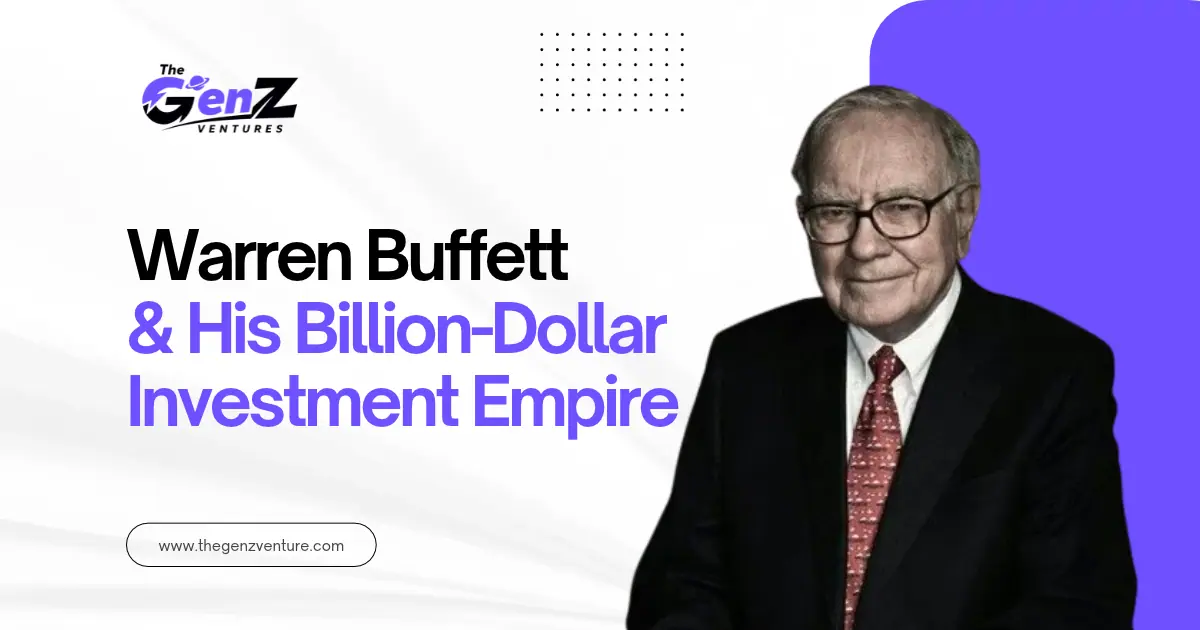
Warren Buffett became one of the world’s greatest investors and built his multi-million-dollar empire through disciplined value investing, lifelong commitment to compound interest, patience, and reinvesting insurance float.
If you don’t find a way to make money while you sleep, you will work until you die. Widely linked to Warren Buffett, this quote shows his approach to building wealth through assets and businesses that can provide value in the long term. This principle is greatly reflected over the course of his life as well, from earning a 5-cent profit from Coca-Cola bottles to holding around 9.3% of the company, which his company, Berkshire Hathaway, owns.
His journey is filled with long-term, calculated, and patient decisions that helped him become the world’s richest person in 2008, at 77.
Table of Contents
Who Is Warren Buffett?
Warren Buffett is an American investor, businessman, and philanthropist who is also recognized among the world’s greatest and most successful investors. He is commonly known as the “Oracle of Omaha” as he built his multi-million-dollar empire by living in his hometown, Omaha, Nebraska, and sharing his investing wisdom and financial guidance.
He built his huge fortune through early saving, disciplined value investing, and transforming Berkshire Hathaway into an insurance-funded corporation. In 2026, he continues to rank among the world’s richest people with a net worth of around $145 billion.
Warren Buffett’s Early Life and Education
Warren Edward Buffett was born on August 30, 1930, in Omaha, Nebraska. His father, Howard Homan Buffett, was a stockbroker and U.S. Congressman, and his mother was Leila Stahl Buffett.
Warren was born second of the three children; the first was his older sister, Doris Buffett, who was a retail philanthropist and died in 2020. The third one is Roberta “Bertie” Buffett Elliott, a philanthropist and donor to Northwestern University.
From childhood, Warren showed an intense interest in numbers, memorizing city populations, statistics, and doing complex arithmetic. At the age of 6, he went to his grandfather’s grocery store and bought six packs of Coca-Cola for 25 cents. Then, he sold each bottle for a nickel and made 5 cents profit.
Warren completed high school in Washington, D.C., in 1947. During his teenage years, he was already a successful investor. At the age of 16, he had to enroll in the University of Pennsylvania’s Wharton School because his father urged him to do so.
After getting enrolled, he wanted to leave just after one year, as he felt the program was too theoretical. Then, he was transferred to the University of Nebraska–Lincoln, where he completed his Bachelor’s of Science in Business Administration at the age of 19 or 20.
For his graduation, he applied to the Harvard Business School, but was rejected. After getting rejected, he then went to the Columbia Business School, where he earned his master’s degree and studied value investing under none other than Benjamin Graham.
How Warren Buffett Started His Business Journey
Warren Buffett started his business journey at a surprisingly early age. He started by selling chewing gum and weekly magazines, which he sold door-to-door. He also delivered many Washington Post newspapers, through which he earned a lot of money during his teenage years.
Early hustles of Warren’s business journey:
- Selling Door-to-Door
- The Paper Routes Business
- The Pinball Venture
- The First 6 Shares
- The Farmland Ownership
Warren Buffett’s First Investments and Businesses
The story of Warren’s first investments and businesses takes us to his teenage days, where he sold papers and magazines, started a business, and bought shares.
Before hanging out a lot at his father’s brokerage firm, he ran a profitable pinball machine business in a local barbershop. He bought the machine for just $25, and after expanding it in several shops, he sold it for about $1,200.
At the age of 11, he bought 6 shares of Cities Service Preferred, 3 for himself and 3 for his sister, each for $38. The shares quickly fell to $27 before bouncing back to $40. After this, he sold the shares and learned one of his first lessons: patience, as the shares later surpassed $200.
When he reached 14, he was already running his huge paper route business. He also bought a 40-acre farm for $1,200, which he saved from this paper business. From 14 to 16, he was studying and creating a passive income from his side hustles, which also made him different from other kids his age.
How Warren Buffett Built Berkshire Hathaway
Until Warren Buffett arrived, Berkshire Hathaway was a failing textile mill. In 1962, he bought the shares of the company and took control of most of the shares in 1965, due to dissatisfaction with management over a broken buyout promise.
Later, he purchased the National Indemnity in 1967, marking his entry into the insurance market and creating an economic foundation for Berkshire Hathaway. In 1972, he purchased another company, See’s Candies, with Charlie Munger’s guidance. By 1985, he shut down the textile mills that were horribly unprofitable for him.
For approximately 20 years, Buffett kept operating the textile business of Berkshire, but continuously directed the capital into insurance and other notable businesses. Then, in 1985, he chose to close the textile operations of the company.
Warren Buffett’s Investment Philosophy
The investment philosophy of Warren Buffett revolves around buying a fraction of ownership of a high-quality business at fair prices and holding it for the long term. This philosophy of his is reflected across major compounding investments that he has made in his life.
For example, he purchased 23 million shares in 1988, and over time, he multiplied them in 1990, 1992, 1996, and 2012, before reaching 400 million shares at present, which are owned by his company, Berkshire Hathaway.
At present, Warren Buffett holds the position of Chairman Emeritus of Berkshire Hathaway, remaining on the board, while his son Howard Buffett holds the position of chairman of the company.
Warren Buffett’s Biggest Investment Decisions
Warren Buffett’s biggest investment decisions not only involve major wins, but also some costly mistakes and losses as well, teaching us that failures are just a part of the journey.
Look at the table and explore these biggest investment decisions:
| Investment | What Happened | Result |
| Coca-Cola | Bought heavily in 1988 | Huge long-term win |
| GEICO | Built a major stake and later owned the insurer | Major success |
| American Express | Invested during a crisis | Major long-term win |
| Apple | Started buying in 2016 | One of Berkshire’s biggest winners |
| See’s Candies | Bought the company in 1972 | Shaped Buffett’s investment philosophy |
| Dexter Shoe | Bought it for $433M using Berkshire shares | Costly mistake |
| US Airways | Invested heavily in the struggling airline | Buffett later called it a mistake |
| Tesco | Held on too long as problems emerged | Significant loss |
| Amazon | Entered the stock relatively late | Missed much of its early growth |
| Berkshire missed an early investment opportunity | Notable missed opportunity |
Warren Buffett’s Business and Leadership Strategy
The business and leadership strategy of Warren Buffett centers around operational autonomy, non-compromising integrity and ethics, and shifting focus to long-term capital growth, rather than short-term gains.
The business and leadership strategy of Warren Buffett is grounded in:
- Economic Moats
- Intrinsic Value
- Insurance Float
- Ownership Mentality
- Laissez-Faire Autonomy
- Zero Bureaucracy
- Zero-Tolerance Ethics
- Rational Capital Allocation
Warren Buffett’s Major Achievements
In his lifetime, Warren Buffett achieved several major business and investment milestones that include:
- Turned Berkshire Hathaway from a mill into one of the world’s most valuable conglomerates.
- Made himself one of the world’s most successful long-term investors.
- He diversified business sectors of Berkshire Hathaway across insurance, energy, railroads, consumer brands, and others.
- Established huge long-term holdings in major brands such as Coca-Cola, American Express, and Apple.
- He also became a mentor for millions, who taught the value of a value-investing approach, patience, and compounding.
- He has been publishing the Berkshire Hathaway Letters to Shareholders since 1965, on topics such as his investment rationale, market views, and corporate governance.
- Launched a charitable campaign, the Giving Pledge, in 2010, along with Bill Gates and Melinda French Gates.
- He also served as chairman and CEO of Berkshire Hathaway for over five decades, since 1970, before stepping down by the end of 2025.
Warren Buffett’s Net Worth and Sources of Wealth
As of 2026, the net worth of Warren Buffett is approximately $145 billion, making him one of the richest people in the world. He has earned so much wealth from his businesses and smart investments over the years.
The major sources of Warren Buffett’s wealth:
- Berkshire Hathaway Stock represents roughly 99.5% of his total net worth.
- He owns approximately 38.2% of the Berkshire Hathaway outstanding Class A stock.
- He also holds a minor fraction estimated at under $1 billion in personal liquid assets.
- He created over 99% of his wealth through long-term holding at the age of 65.
Warren Buffett’s Philanthropy
Apart from being one of the wealthiest investors, Warren Buffett’s also plays his part as a philanthropist. This is visible through the Giving Pledge initiative, which he co-founded with Bill Gates and Melinda French Gates in 2010.
He has pledged to give away over 99% of his wealth to donations to help the needy ones. From 2006 to the early 2020s, he has donated tens of billions to the Bill & Melinda Gates Foundation as well.
Here are some of his family foundations:
Susan Thompson Buffett Foundation
- Founded: 1964
- Founder: Warren Buffett
- Focus Areas: Reproductive Health & Rights and Nebraska College Scholarships
Howard G. Buffett Foundation
- Founded: 1999
- Founder: Howard G. Buffett
- Focus Areas: Global Food Security, Conflict Mitigation & Resolution, and Countering Human Trafficking
The Sherwood Foundation
- Founded: 1999
- Founder: Susan Alice “Susie” Buffett
- Focus Areas: Early Childhood Education, Social Justice & Equity, Human Services, and Civic Engagement & Advocacy
NoVo Foundation
- Founded: 2006
- Founder: Peter Buffett and Jennifer Buffett
- Focus Areas: Empowerment of Women and Girls, Social-Emotional Learning (SEL), and Regional Community Investment
Business Lessons from Warren Buffett
Here are some of the business lessons that you can learn from Warren Buffett:
- Build an economic moat (a company’s ability to maintain competition with its market rivals and protect its long-term profits and market share).
- Invest only in businesses you truly understand
- Do not fall for the trendy sectors outside your expertise.
- Work to build a business that can happily operate for the next 10 years.
- Consider compounding and let the interest build over decades.
- Always protect your capital.
- Consider maintaining a strict margin of safety on each purchase you make.
- If you sell in a panic, it may affect your long-term portfolio.
- Always protect your corporate reputation and integrity.
- Work on an organizational culture that includes values, beliefs, attitudes, and everyday behaviors.
Frequently Asked Questions About Warren Buffett
- What is Warren Buffett’s daily routine like?
Warren Buffett follows a strict daily routine, including 8 hours of sleep, reading for around 5 to 6 hours, minimal meetings, and following his hobbies.
- What books does Warren Buffett recommend for investors?
Books that Warren Buffett recommends for investors are:
- The Intelligent Investor by Benjamin Graham
- Common Stocks and Uncommon Profits by Philip A. Fisher
- Security Analysis by Benjamin Graham and David Dodd
- The Outsiders by William N. Thorndike Jr.
- The Most Important Thing by Howard Marks
- What is Warren Buffett’s approach to risk?
Warren Buffett views risk as a permanent loss of capital, not short-term market volatility, that occurs from a lack of knowledge.
- Does Warren Buffett still invest in stocks?
No, Warren Buffett is no longer investing in stocks.
- What is Warren Buffett’s favorite stock?
Warren Buffett’s favorite stock is Coca-Cola, which he also famously called his “forever” stock.
Conclusion
Warren Buffett built his investment and business empire through compounding, smart and disciplined value investing, and a lifelong commitment to patience. In his journey, he also made some wrong decisions and investments, but he chose to learn and make informed decisions.
Apart from this, he also donated billions of dollars as donations as an effort to make society a better place to live. His inspiring wisdom on the value of compounding, the circle of competence, and business moats has inspired many investors and business people.
If you found the story of Warren Buffett interesting and learned something new, you may also want to know about other inspiring businessmen, like Steve Jobs and Jeff Bezos. On our platform, Gen Z, we feature stories of entrepreneurs and leaders who made huge differences through their innovative ideas and execution. Thus, visit our platform to read about some of the most influential people in the world.
Also Read : Mark Zuckerberg’s Success Story: How He Built Facebook from a College Dorm