
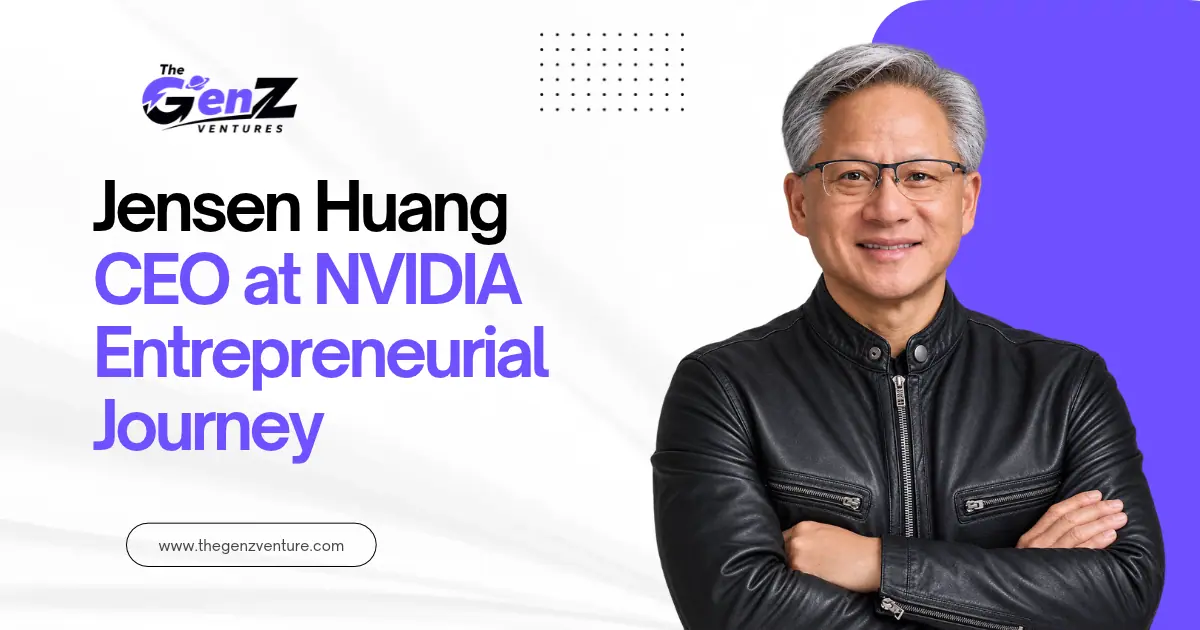
Jensen Huang is the co-founder, president, and CEO of NVIDIA, which is one of the most successful tech firms on the planet. He is a well-known figure in the world of graphics technology who contributed to the development of modern-day AI (Artificial Intelligence).
He helped NVIDIA emerge from the startup phase as an important supplier of hardware solutions commonly used in video gaming, data centres, scientific research, etc.
However, the road to success for Mr. Huang wasn’t easy. He moved to America as a young boy, worked at a fast food restaurant during adolescence, studied electrical engineering, and gained years of experience in the field of computer chips until he started his company. His life demonstrates that technical expertise, diligence, and an ability to make fateful decisions are critical for success in business. Let’s have a closer look at his personal and professional journey throughout the years.
Who Is Jensen Huang?
- Full name: Jen-Hsun Huang, commonly known as Jensen Huang.
- Date of birth: February 17, 1963.
- Place of birth: Taipei, Taiwan.
- Profession: Technology entrepreneur and business executive.
- Company: NVIDIA.
- Role: Co-founder, president, and CEO.
- Education: Bachelor’s degree from Oregon State University and master’s degree from Stanford University, both in electrical engineering.
Jensen Huang, more commonly known as Jen-Hsun Huang, is an entrepreneur and leader in the tech industry who was born in Taiwan. He was the co-founder of NVIDIA in the year 1993 along with Chris Malachowsky and Curtis Priem. Since the founding of the company, Huang has been serving as its president and CEO.
NVIDIA is a company popular for its graphics processing units (GPUs). GPUs were initially used to enhance the graphics performance of computers and gaming during their first launch. Since then, GPUs have evolved to be significant in the field of AI processing. Currently, NVIDIA produces chips and software that assist companies in creating and deploying AI applications.
Early Life: Taiwan and Thailand
Jensen was the younger of the two sons of his parents. His father was a chemical engineer, and his mother was a teacher. The family kept moving from place to place. When Jensen was five, the family moved to Thailand because of the father’s job. The father thought that America was the right place for his sons. The mother did not know any English, but she made her boys learn ten words in English from a dictionary every day. The boys learned a little English before moving to America.
Moving to America: A Hard Start in Kentucky
When Jensen and his brother were nine years old, they were sent to stay with their uncle in Washington. Their parents remained in their place to earn money and arrange other things. Later, the uncle put the boys in Oneida Baptist Institute in Kentucky, thinking that it was a good school. In fact, it was a reformatory school.
Life there was tough:
- Jensen cleaned the dormitory toilets every day.
- Jensen was bullied for his accent and appearance.
- He taught his illiterate roommate to read, and the roommate taught him to bench press.
About two years later, his parents arrived in the U.S., and the family settled near Portland, Oregon. Jensen still says the Kentucky years shaped his toughness. He later donated millions to the school.
High School and First Job
At Aloha High School in Oregon, Jensen finished school at 16 after skipping two grades. He was also a nationally competitive table tennis player. Besides this, he began programming on the Apple II at the school. After turning 15, he worked as a dishwasher, a busboy, and a waiter at Denny’s. He claims working at rush hours taught him how to handle difficult situations.
How NVIDIA Started
Chris and Curtis wanted to start a startup and asked Jensen to be part of it. Jensen was quite happy and agreed only to discuss it with them first. The three friends met at Denny’s in East San Jose, drank cheap coffee, and discussed many ideas. They realized that personal computers were becoming popular, and people liked playing games, so they decided to produce microchips for 3D graphics.
Jensen joined, and NVIDIA was officially incorporated on April 5, 1993. He was 30 and became CEO from day one. Wilfred Corrigan, the head of LSI Logic, introduced him to Don Valentine of Sequoia Capital. Jensen admits his pitch went badly, but Sequoia invested anyway because of his strong reputation. Years later, Denny’s placed a plaque on that booth calling it the booth that launched a trillion-dollar company.
The name “NVIDIA” comes from “invidia,” a Latin word meaning envy. The founders wanted competitors to burst from envy.
Near Failure: 30 Days From Going Out of Business
Nvidia encountered numerous challenges during its early years. Here is a closer look:
- Failure of the NV1: The first-ever chip was too complex and costly to produce and distribute. Out of the 250K items sold to partners, pretty much all of them were returned.
- Backward Compatibility: Nvidia designed advanced chips using quadrangles, but Microsoft’s software was based on triangles. Therefore, things did not work out.
- Generosity of Sega: Jensen prompted the CEO of Sega to terminate the deal but pay Nvidia in full. He did it, and Nvidia received nearly $5 million, which was enough for the company to survive.
- Layoffs and a Final Chance: Jensen downsized the company in half and bet everything on one chip which had to succeed in the market of hi-tech.
The Big Bet: CUDA and AI
By the mid-2000s, video game development was beginning to slow down. Around 2006, NVIDIA released the CUDA software, which enabled programmers to harness graphics processors to perform computer tasks other than video gaming. Scientists soon realized that video card technologies were capable of being transformed into affordable supercomputers. This trend was especially exploited by Andrew Ng and other researchers, who concluded in the late 2000s that they could train neural networks 10 to 100 times faster utilizing graphics chips instead of traditional processors.
Despite the fact that the AI sector was yet to reach the billion-dollar mark at the time, Jensen decided to invest in AI with his whole heart. In 2016, he delivered the world’s first AI-powered supercomputer to OpenAI. By the time ChatGPT appeared on the market in 2022, NVIDIA was completely ready for it. Its data center division’s revenue share grew from 40% to nearly 90%. NVIDIA raised its capitalization to over $2 trillion in June 2024 and as much as $5 trillion in October 2025.
Lessons From Jensen Huang’s Story
- Hard times build strong people: His childhood and NVIDIA’s near collapse taught him resilience.
- Start from first principles: If you believe in a future, take the first step.
- Be patient: Sequoia calls NVIDIA an overnight success that took 30 years.
Conclusion
Jensen Huang went from cleaning toilets in Kentucky and washing dishes at Denny’s to leading the company at the center of the AI era. His journey shows that patience, hard work and bold bets can change an industry. Therefore, his story has set a standard for many aspiring entrepreneurs who are facing failure while building something meaningful.
If you are also an entrepreneurial enthusiast and love reading such inspiring business stories, visit our platform The Gen Z Ventures. At our platform, we publish the stories of such influential business owners who have dealt with critical challenges throughout their business journey and have made their mark in the industry.
Also Read : Michael Dell: How He Built Dell Technologies into a Global Business