
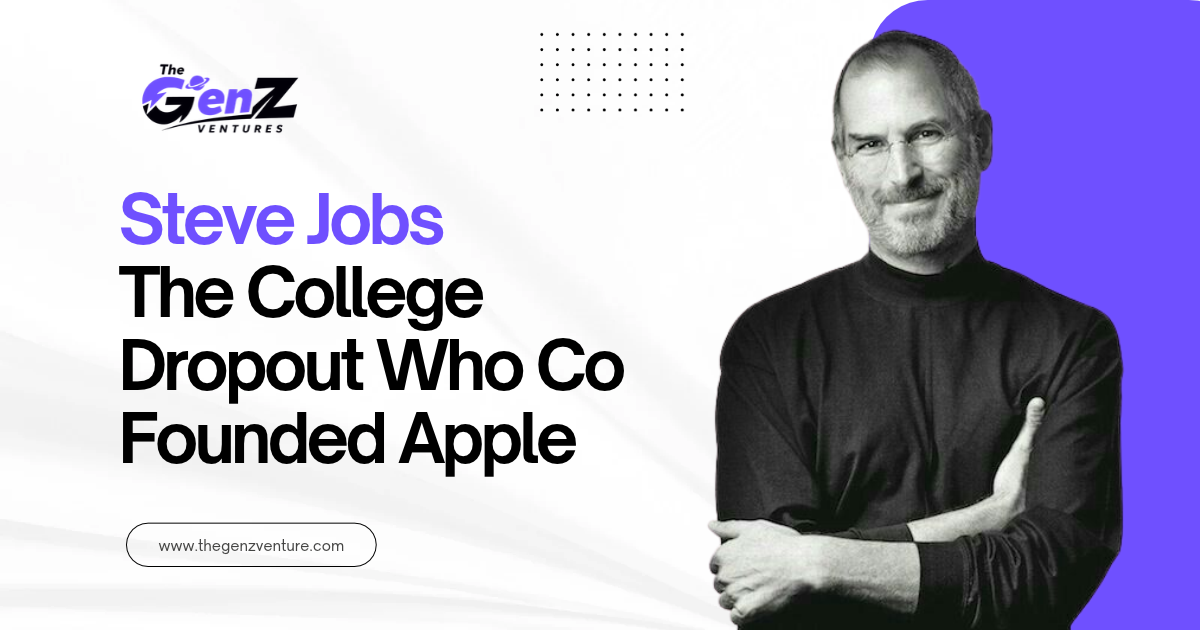
Steve Jobs dropped out of Reed College just after one semester but went on to co-found Apple in 1976, transforming personal computing and technology. He co-founded the company in his family’s garage with Steve Wozniak and Ronald Wayne in Los Altos, California.
When you hear of a “college dropout,” you might think of a person who could not or failed to complete their college education. But with Steve Jobs, the story completely flips. Even after dropping out of college just after the first semester, struggling financially, and choosing an unclear path, he co-founded a company that has a valuation in trillion dollars. But how? Well, this is the story of a man with curiosity, an entrepreneurial mindset, and an interest in experimenting with electronics who built a multi-billion-dollar tech company, starting in his family garage.
Table of Contents
Early Life of Steve Jobs
Steve Jobs was born in San Francisco in 1955 and raised by his adoptive parents, Paul Reinhold Jobs (his father) and his mother, Clara Jobs. The biological parents of Steve are Abdulfattah Jandali, a Syrian-born political science professor and immigrant, and Joanne Carole Schieble Simpson, a German-Swiss speech therapist.
When he was born, his parents were unmarried and were still pursuing their graduation degrees. They gave Steve up for adoption with a strict condition that only parents with a college degree would be allowed to take on his responsibility. However, his adoptive parents, Paul and Clara, had not completed college but promised to get him a college education.
Steve grew up in Mountain View and Cupertino, California, which is now known as Silicon Valley. His father was a machinist who worked on cars and electronics in the family garage, the same place where Apple’s journey began. From an early age, he showed a strong interest in electronics and mechanics, which his father taught him to take apart and rebuild.
Moving a little forward in his story, he also hated going to school, like any child. For him, schooling was painfully boring for him, which is why he used to do pranks in his classroom. This little terror of his led to many suspensions, and eventually he had to leave the school after the third grade.
In middle school, he became a quiet and alone kid because he was constantly bullied. Later, he asked his parents to move him out of the school to a new one, which his parents had to agree to, as he proposed to drop out.
Why Steve Jobs Dropped Out of College
The college years, as expected, were not too good for Steve Jobs. In 1972, after enrolling in English Literature, he could not see any financial or personal value in continuing his education.
Another reason is that after seeing his parents spending their life’s savings on his education, he found no meaning in staying. As a result, he dropped out just after six months, or the first semester of the programme.
However, he continued to study other subjects, such as calligraphy, modern dance, and Shakespeare. He attended classes for these subjects without an academic degree in them. This attitude of Steve shows that learning does not always need a degree; if you have curiosity, this world becomes your teacher.
“Stay hungry, stay foolish” — Steve Jobs
Not to mention, he did not have a dorm room to live on campus, so he had to live with his peers and sleep on their room’s floor. Steve also faced many financial and food-related problems in those years. He used to collect empty soft drink bottles to return them for 5 cents to buy food.
And sometimes, to get access to delicious meals, he used to walk around 7 miles (11 km) to a Hare Krishna temple every Sunday to get free weekly food. Who would have thought that this person would co-found Apple and become a multi-billionaire?
Steve Wozniak and the Birth of Apple
Steve Jobs met Steve Wozniak through a mutual friend, Bill Fernandez, in 1971. He was 16 years old and was studying at Homestead High School in Cupertino, California, whereas Steve Wozniak was 21 years old and was already in college.
Within a short time, Steve and Woz became close friends. Their bond grew stronger because of the shared love for electronics, clever engineering, and practical jokes. They had a lot of fun during this time, including famous pranks, such as:
- The Vatican Prank
This one prank contains the most thrill. By using a custom-built digital Blue Box, Wozniak called Vatican City, pretending to be U.S. Secretary of State, Henry A. Kissinger. The person who answered the call from the other side actually believed him and said they could wake him up, but discovered that it was a prank.
- International Calls
Steve and Woz used to make international calls pretending to be telephone operators. They used to do this with the Blue Box that allowed them to call for no charge. Both used to do this to have fun and understand how the telephone networks worked.
- TV-Scrambling Remote
Steve Wozniak shared that he built a small, portable device that could interface with television signals. He used to secretly activate that device when people were watching TV. This used to make the picture look distorted, making them fix it without realizing it was actually Woz.
- The Ticking Metronome
This one is older, but still worth reading. When Woz was in 12th grade, he built an electronic metronome only to realize later that it sounded like a time bomb. Then the idea of placing that device in a school’s locker tickled his mind. This caused chaos in the school, panicking the principal and involving police in the whole event.
- The Graduation Banner
Steve and Woz both worked on the graduation banner prank with Allen Baum in high school. They planned to drop a banner during the graduation ceremony, showing a saluting hand with a middle finger on it. But another student discovered the banner before this legendary prank came into existence.
Apple: From Garage to Technology Giant
Apple was founded in 1976, when Steve Wozniak designed and built the computer circuit board out of passion for electronics. Steve Jobs saw this and realized: what if people had their personal computers? He then convinced Woz to sell it as a commercial product.
Steve Jobs raised initial money by selling his Volkswagen minibus, along with Steve Wozniak, who also sold his HP-65 calculator for $500. They both assembled the circuit boards in the family garage of Steve Jobs in Los Altos, California.
Apart from them, there was a third person involved in co-founding Apple, Ronald Wayne. His role was to write the original 1976 partnership agreement for Steve and Woz, design the original logo for the company, and hold 10% of the company to avoid disputes between Steve and Woz.
For those who do not know, Wayne also wrote the official Apple-1 operations and technical documentation. However, for some reason, he sold the 10% stake back to Steve and Woz for $800 just 12 days after signing the agreement.
The Timeline of Apple’s Journey
Look at the timeline of Apple’s journey given below:
- April 1, 1976: Steve Jobs, Steve Wozniak, and Ronald Wayne founded Apple Computer.
- 1976: The Apple I computer was introduced as an affordable personal computing and video terminal device, making it easily accessible to the general public.
- 1977: After the success of the Apple I, the Apple II was released with HD color graphics and sound.
- December 12, 1980: The company sold 4.6 million shares at $22 each, making Steve Jobs and Steve Wozniak millionaires.
- January 24, 1984: Apple launched the Macintosh, an affordable and easy-to-use computer.
- 1985: After the launch of the Macintosh computer, sales went down, and tensions built between Steve Jobs and John Sculley. In May 1985, Apple’s board of directors sided with Sculley, making Steve Jobs resign from his own company in September of the same year.
- 1990s: Apple faced many financial and leadership problems.
- 1997: Apple was about to go bankrupt, so they had to bring Steve back by buying NeXT for $427 million, which he also founded by him.
- 1998: After the return of Steve Jobs to the company, Apple released the iMac G3 that saved the company from falling apart.
- January 9, 2001: Apple released iTunes, a digital jukebox software for Mac users, allowing them to import CDs and compress music into MP3 files.
- October 23, 2001: The iPod, a portable MP3 player, was released with the slogan “1,000 songs in your pocket.”
- January 9, 2007: Apple released its first iconic iPhone and changed its name to Apple Inc.
- January 27, 2010: The original iPad was launched on this date, with millions of units sold in just 28 days.
- 2011: Steve Jobs had to resign as the CEO of Apple in August 2011 due to rare pancreatic cancer. Just two months later, on October 5, 2011, Apple lost its visionary leader.
- 2015: Many products were launched by Apple, including Apple Watch, iPhone 6s and 6s Plus, iPad Pro, and Apple Music as a subscription-based streaming platform.
- 2018: 2018 was a milestone year for Apple Inc., as it became America’s first public company to reach a valuation of $1 trillion.
Today, the market valuation of Apple has reached approximately $4.61 trillion to $4.67 trillion in September 2026.
Lessons to Learn from Steve Jobs’ Journey
The journey of Steve Jobs, that has been very inspiring for many people. It reminds us that there is no single path to success and no path is easy. He left college, followed what caught his interest, grabbed the opportunity at the right time, and made the decision to execute a simple, visionary idea.
Even after founding Apple, he had to resign from the company, but his resilient attitude led him to found NeXT with five former Apple employees. After returning to the company, he kept on innovating and played a major role in the unbelievable success of the company.
His story reminds us that we should not let our curiosity die; we should cherish it, learn from our experiences, fail, and work on ideas that matter, even if the path is unknown and things do not go as we planned.
Conclusion
Steve Jobs, a man whom we know as a college dropout, did not have an easy life. He had to leave college to figure out what he wanted to do in life. Even after dropping out, he did not stop learning, reflecting his curiosity and attitude towards learning. Later, even after his resignation did not stop him from innovating and transforming technology, inspiring thousands of people even today.
If you found the journey of Steve Jobs exciting and inspiring, consider reading more stories like this on our platform. At The Gen Z Ventures, we feature many extraordinary stories of brands, founders, and entrepreneurs. Thus, explore those stories and find what feels most encouraging.
Also Read : From A Garage Startup to a Multi-Billion-Dollar Empire: Amazon