
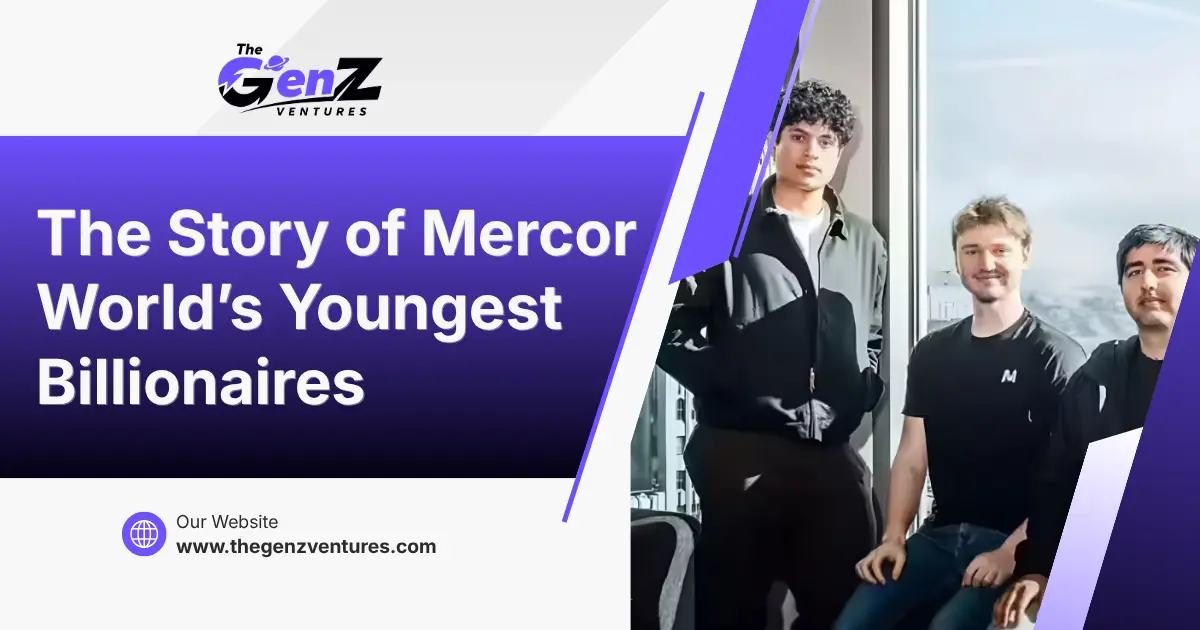
New generation entrepreneurs must take inspiration from startups like Mercor, one of the most outstanding startup journeys led by young individuals. Three high-school friends, Brendan Foody (CEO), Adarsh Hiremath (CTO), and Surya Midha (Board Chairman), from the Bay Area, built Mercor, an AI-powered marketplace that connects companies with global experts who can train AI. It started with a curiosity regarding technology and problem-solving and quickly transformed into a billion-dollar company that shapes the future of work and artificial intelligence.
Therefore, this Gen Z-led startup by 22-year-old young individuals flourished into a multi-billion-dollar valuation ($10 billion) company, making them one of the youngest self-made billionaires in the world. This reflects how Gen Z founders are shaping entrepreneurship through speed, ambition, and execution.
Can you briefly introduce yourself and tell us about your business?
We, Brendan Foody, Adarsh Hiremath, and Surya Midha, are the founders of Mercor, a leading AI-powered marketplace that connects global businesses with talented professionals who help to train advanced AI systems. Foody is Mercor’s CEO, Hiremath its CTO, and Midha holds the role of board chairman.
Mercor acts as an intermediary between labor markets and artificial intelligence. It allows experts from fields like law, finance, medicine, and engineering to contribute to AI model training for several businesses. Therefore, what started as a small idea during early academic years has now grown into one of the global ventures that reshape how work and AI development interact.
What inspired you to start a business at such a young age?
We met at Bellarmine College Preparatory School in San Jose. We were very interested in redesigning work itself with technology. In high school debate and in early college, we were always thinking about systems, efficiency, and global labor, with ideas.
Later, in a hackathon in São Paulo, we learned that talent matching could be done globally in a much more scalable way than we had thought. That moment taught us that we didn’t have to wait for the “right time”. Rather, we could start building immediately. This idea clicked in our minds and inspired us to take action to solve this real-world problem in the most efficient way possible.
What challenges come with being a young founder that people often overlook?
One of the biggest challenges is being underestimated, especially in high-stakes conversations with investors and enterprise customers. We also had to learn everything quickly, product design, hiring, fundraising, operations, with no traditional experience. Another underrated challenge is the emotional intensity of making something at such a young age. People rarely see that balancing company growth at a rapid pace while still developing as individuals is one of the biggest challenges in itself.
What’s one stereotype about young entrepreneurs that you want to break?
The biggest stereotype is that young entrepreneurs succeed mostly because of luck, hype, or perfect timing. But in reality, a lot of the progress we made came from steady doing the work, trying things out, then iterating again and again over time.
Moreover, as young founders, we have spent countless hours polishing ideas, checking assumptions, and learning from failure, not really from magic moments, which people often believe. Success is usually the byproduct of continuous attention and effort, rather than one sudden breakthrough. However, the outer story sometimes makes it seem effortless, but it is really not like that. Thus, we had to go through several challenges to make it work in today’s competitive global market.
Did social media or online communities play a role in your growth? How?
Yes, online platforms and communities helped a lot, playing a real role in validating the idea and finding the first early users. Platforms like X (Twitter) and professional communities played a huge role in early visibility. Brendan Foody has often shared insights publicly, including how Mercor evolved and how it grew rapidly.
The feedback we got from the internet made it clearer what companies actually needed, and how our product could move forward, and change. Social media also lets us share progress, connect with professionals across the world, and build credibility in a space where trust and visibility matter a ton, especially for early-stage startups.
What was your biggest fear when you launched your idea publicly?
Honestly, our biggest fear was that no one would care about what we were building. When we put Mercor out there, it meant taking a risk, facing rejection, maybe getting criticized, or just hearing silence. Leaving institutions like Harvard and Georgetown, we knew that we were definitely stepping into uncertainty.
Also, there’s that uneasy uncertainty when you leave structured paths like college to pursue something that’s still unproven. Still, we realized pretty early that not launching at all would be an even bigger risk than failing publicly, so we went with action over hesitation.
Have you faced age bias from investors, partners, or customers? How did you handle it?
Yes, there were some hesitations early on from investors and enterprise clients because of our age. So instead of convincing people by means of argument, we concentrated entirely on demonstrating results.
As Mercor grew and paid $1.5 million per day to experts in its marketplace in just 2 years of operations, the conversation naturally shifted from age to impact.
As we started to show traction, revenue growth, and product reliability, perception changed organically. Therefore, the best answer to any questions of our credibility or experience was execution.
What does success mean to you at this stage of your life?
Success for us is not just valuation or recognition, even though Mercor reached a $10 billion valuation after its $350 million Series C round led by Felicis, with participation from Benchmark, General Catalyst, and Robinhood Ventures.
Also, recently, Forbes recognized us as the world’s youngest self-made billionaires. However, success at this stage is around building something that compounds in value and impact over time.
Moreover, it’s about developing a system that adds real value to the interaction between work and intelligence. Success also means being deeply engaged in the problem that we are solving and being curious enough to start building in the first place.
How do you hire or work with people from older or younger generations?
We welcome talent at any age, valuing expertise, judgment, and alignment with our mission. Our team consists of professionals from all walks of life and experience levels. In fact, cross-generational work makes us better decision makers as it brings together fresh vision and deep industry knowledge. The goal is always to build a culture where ideas win over hierarchy or seniority.
How has being a Gen Z founder shaped the way you build your company?
As Gen Z founders, we are more comfortable with speed, iteration, and experimentation. We like to build fast, learn from feedback, and test in real environments, not overplan. This helps us respond more quickly to changes in AI and labor markets. It also encourages us to stay close to our users and iterate on what we’re building.
What’s one small win that meant a lot to you in the beginning?
An early meaningful win was connecting our first clients with skilled engineers and watching the model work in real time. That early validation made it clear our concept wasn’t only theoretical. It could become real, practical, and useful. We also saw that a global talent marketplace backed by technology could run and generate actual economic value.
What motivates you on days when things aren’t going as planned?
We get motivated by thinking about the long-term impact of what we’re building. The belief that our effort could reshape how humans and AI cooperate gives us a kind of relief, even when the days feel off. Progress isn’t always instant, but if we focus on compounding results and tackling real problems, it helps us stay steady and stay committed to the mission.
What excites you the most about the future of your industry?
To be honest, we are mostly excited about the way AI will rearrange knowledge globally. When AI systems get stronger, the human part starts to shift, not so much disappearing, but more like teaching, navigating, and polishing these models. It also feels like we’re creating a whole new kind of work, where human judgment becomes even more important.
How do you see your generation changing the broader startup ecosystem in the next 5–10 years?
We think this generation will make entrepreneurship feel more global, faster, and a lot more experimental. Launching a company won’t mean waiting years for experience or relying on old-style pathways. Instead, young founders will validate ideas earlier, iterate quickly, and scale with more speed. That shift will end up changing how startups are built and grown across the world.
What advice would you give to brand-new entrepreneurs for building a successful business?
Start early, and focus on learning from real users, not from theory. Move fast, test your assumptions early, then iterate based on feedback. Consistent execution usually beats having a “perfect idea” in your notes. The biggest move is probably just starting, and sticking with continuous improvement, even when it feels messy at first.
Also Read:
Copyright Disclaimer
The views and opinions expressed in this article are solely those of the author and are based on independent research and analysis. The content published on The GenZ Ventures is protected under applicable copyright laws. Any unauthorized copying, reproduction, distribution, or republication of this material, in whole or in part, without prior written permission from the original author or website owner, may result in legal action under the applicable laws of the land.